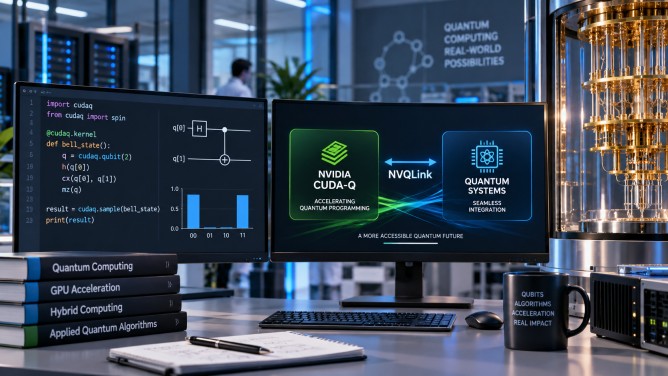
Quantum Machines has unveiled a groundbreaking demonstration that integrates NVIDIA’s CUDA-Q program with live qubits and classical PPU processors, all connected through NVIDIA’s NVQLink. This innovation presents a new methodology for crafting hybrid quantum-classical applications. By merging Quantum Machines’ quantum control capabilities with NVIDIA’s CUDA-Q open platform, the demonstration showcases the potential for quantum-GPU computing. NVQLink plays a pivotal role in this setup, ensuring a high-speed linkage between quantum controllers and accelerated computing systems, thereby streamlining the development process for quantum applications. Developers can now employ familiar programming languages such as Python, C++, or QUA without delving into the intricate low-level control sequences that quantum hardware traditionally demands.
During the demonstration, code written with CUDA-Q was seamlessly executed using Quantum Machines’ control stack across a variety of processors, including quantum processors, GPUs, and CPUs. This system adeptly assigns different segments of a workload to the most suitable processor. A key component, NVIDIA NVQLink, facilitates swift communication between quantum and classical computing resources, completing the data exchange in just about one microsecond. This technological advancement is currently being showcased at IEEE Quantum Week in Toronto, offering researchers and engineers the opportunity to witness the system’s operation with live quantum hardware. Yonatan Cohen, CTO of Quantum Machines, expressed satisfaction with the collaboration with NVIDIA, emphasizing the potential to accelerate the journey towards large-scale quantum computers.
Quantum processors, known for their specialized systems and programming requirements, are being made more accessible through this integration, functioning now as a component within a broader computing ecosystem that includes CPUs and GPUs. NVIDIA’s Director of Quantum Product, Sam Stanwyck, highlighted the transformative potential of quantum processors when synergized with GPUs and CPUs, forming a cohesive quantum supercomputing system. The integration of NVIDIA NVQLink into Quantum Machines’ Orchestration Platform connects the hardware managing qubits with NVIDIA’s accelerated computing, enabling a low-latency connection essential for real-time quantum-classical processing.
The low-latency capability is crucial for applications that necessitate rapid interactions between quantum and classical processors. This setup allows for the swift transmission of measurement data to classical processors and the return of processing decisions to the quantum control system within microseconds. Such a framework is poised to support future applications that require real-time coordination between quantum and classical computing, including quantum error correction and other sophisticated quantum workloads. Quantum Machines, alongside NVIDIA, continues to refine these low-latency connections, striving to make quantum computing more accessible and scalable.
Legal Disclaimer:
The information contained in this article has been provided by independent third-party contributors, clients, or content partners. We do not independently verify the accuracy, completeness, legality, ownership, licensing, or reliability of submitted content, including text, images, videos, trademarks, or other media materials. The submitting party is solely responsible for ensuring that all content, including images and media assets, complies with applicable copyright, trademark, licensing, and intellectual property laws. We disclaim liability for any unauthorized use of copyrighted or proprietary materials by third parties. If you believe that any content published on this platform infringes your intellectual property rights, kindly contact the author above for prompt review and resolution.