President Donald Trump refused again on Saturday to provide any timeline for ending the US military campaign against Iran, insisting the conflict would last “as long as it’s necessary” even as the economic and human costs multiplied across the region. His remarks came as US warplanes conducted continued strikes on Iran, Iranian missiles hit the UAE, and oil markets registered fresh anxiety about the stability of global energy supply. The war, now in its third week since it began on February 28, showed no sign of moving toward resolution.
The centrepiece of the day’s military activity was Kharg Island, Iran’s primary crude export hub. US planes struck the facility for the second consecutive day, building on Friday’s massive assault that Trump claimed had effectively demolished most of the island. He also warned that Iran’s remaining oil infrastructure could be fully destroyed if Tehran continued to block the Strait of Hormuz. The strait, closed by Iran since the start of the conflict, carries about 20 percent of global oil and gas daily. Trump simultaneously called on China, France, Japan, South Korea, and the UK to send warships to help reopen it.
Iran demonstrated its determination to fight on. Ballistic missiles struck Fujairah in the UAE, forcing a halt to oil-loading operations and prompting Iranian officials to warn civilians near ports and US facilities to evacuate. Tehran’s military threatened attacks on any Gulf energy or economic installation with American ties, while the foreign minister called on Arab states to expel US forces. Iran’s strategy, analysts said, combined survival, sustained retaliation, and a deliberate effort to prolong the conflict until a favourable deal could be reached.
The US Defence Secretary painted a picture of Iranian leadership in disarray, claiming senior figures were in hiding and that Supreme Leader Mojtaba Khamenei had been wounded and possibly disfigured. Iran acknowledged Khamenei’s injury but called it minor. Meanwhile Israel continued to conduct airstrikes across Iran, killing at least 15 people in Isfahan alone. Iran continued firing rockets at Israel simultaneously. The USS Tripoli and 2,500 additional US marines were heading to the region, reinforcing America’s military options without specifying their ultimate purpose.
The human toll was staggering. More than 1,400 Iranians had been killed under sustained bombing, with Lebanon adding 800 more dead and 850,000 displaced from Israeli strikes on Hezbollah. Thirteen Israelis and roughly 20 Gulf residents had also died. Six US troops died in a military aircraft crash in Iraq. The US embassy in Baghdad was struck overnight, triggering an emergency evacuation order for Americans across Iraq. With energy prices rising sharply and Trump offering no exit plan, analysts said the world faced a conflict that could grow significantly worse before it got better.
Trump Refuses to Set End Date as US-Iran War Costs Mount Globally
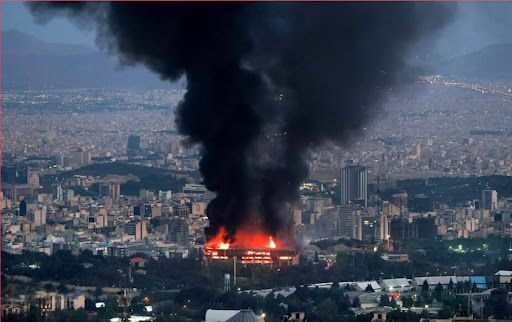
Photo by Mohammad Bornu / Avash Media / Wikimedia Commons (CC BY 4.0)
12