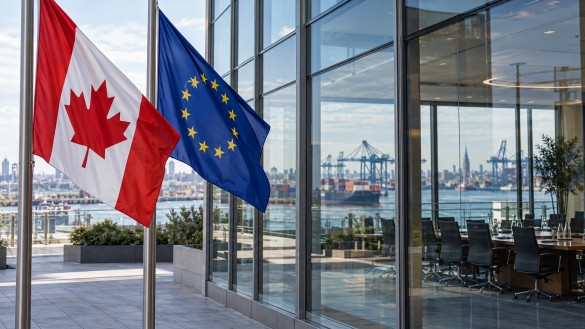
Amid increasing geopolitical uncertainties, Canada and the European Union have unveiled a new partnership named the Alliance for the Future, designed to bolster economic security, enhance trade, and deepen strategic cooperation. Announced in Montreal by Canadian Prime Minister Mark Carney and European Commission President Ursula von der Leyen, this initiative aims to protect shared interests, uphold democratic values, and mitigate vulnerabilities in global supply chains.
The announcement follows Canada’s efforts to diversify its international alliances due to ongoing trade tensions with the United States and concerns over dependency on foreign technology and defense systems. As part of the agreements made at the summit, Canada has committed to contributing to a €90 billion support loan for Ukraine. Additionally, Canada and the EU plan to develop a more integrated economic market, reduce trade and travel barriers, and increase educational opportunities.
A major focus of the new alliance is on technology and artificial intelligence. Canada and the EU have reached an agreement allowing Canadian researchers and companies to access Europe’s supercomputing network for AI model training. Highlighting this cooperation, Carney announced a planned merger between Canadian AI company Cohere and Germany’s Aleph Alpha, which is set to establish joint headquarters in Toronto and Berlin. The Canadian government has indicated a potential investment of up to C$1.6 billion in Cohere.
This closer collaboration is expected to reduce reliance on major foreign technology providers and enhance access to critical resources such as energy, minerals, and semiconductors. Discussions also touched on the possibility of Canada becoming an associate member of the European Union, an opportunity von der Leyen described as a chance to forge a closer relationship with a non-European country. A detailed framework for this potential membership is anticipated at a summit in 2027.
European Council President Antonio Costa expressed his support for the strengthened ties, noting Canada’s close political and cultural connections to Europe. However, the summit was not without controversy, as Quebec’s Premier Paul St-Pierre Plamondon chose not to attend, criticizing the federal government’s handling of provincial representation arrangements.
Despite these internal disagreements, Canada and the EU reiterated their commitment to a robust partnership focused on economic resilience, technological advancement, trade, and international cooperation, underscoring the alliance’s openness to other countries that share their values and objectives.