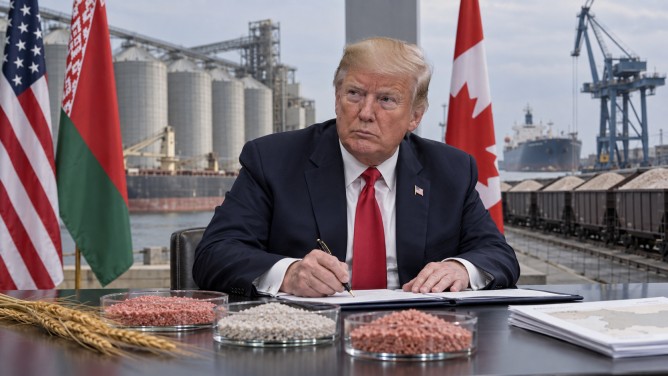
The United States is exploring a significant shift in its agricultural import strategy amid increasing trade tensions with Canada, focusing on Belarus as a potential new supplier of potash fertilizer. This development arises as Washington seeks to diversify its sources for this key agricultural component, traditionally dominated by Canadian imports.
President Donald Trump announced that the U.S. is negotiating a major deal with Belarus to procure potash at a lower cost than current Canadian supplies. This move is intended to benefit American farmers and ranchers by potentially reducing fertilizer prices, which are heavily affected by the cost of imported potash.
The backdrop of this potential deal is the escalating trade dispute between the U.S. and Canada. While Canada remains the largest supplier of potash to the U.S., the Trump administration’s increased trade pressure has prompted the search for alternative partners. Belarus, along with Russia, already contributes to a smaller portion of U.S. potash imports, and a new agreement could significantly alter this balance.
In parallel with these trade negotiations, the U.S. has been working to improve diplomatic relations with Belarus. Recently, Washington eased some sanctions on Belarus following the release of political prisoners by the government of President Alexander Lukashenko. Despite this, the Belarusian government continues to face criticism for its treatment of political opponents and its support for Russia in the Ukraine conflict.
The potential U.S.-Belarus potash agreement could have implications beyond agriculture, affecting diplomatic relations and economic ties. While it promises to alter fertilizer costs and benefit American agriculture, it also raises questions about the broader geopolitical impact, given Belarus’s alliance with Russia and its contentious international standing.